


What is Coaching?
Here's how I think about it. Over 25 years working as a lawyer, a senior leader and now a coach, I've collected some real gems of knowledge about how coaching actually works, and I’ve also seen when it doesn't. As with most things, it’s all about the context and a really clear set up.
Mentoring, training, consulting and advice are all things that put information and ideas in. Coaching does something different.
Coaching pulls out the knowledge, skill, thinking, goals and commitment of the person being coached. The coach doesn't bring all the answers. The coach brings the questions, the space, the insight, the perspective and the steady accompaniment that makes it possible for you to work out what you think. You will work with your coach to create a plan that is right in your context.
Coaching can happen one-to-one or in a group. It can be in person or online. It can run over a few months or over a year. What matters most isn't the format, it's that the person being coached is ready to do the work.

What's the difference between coaching, training and mentoring?
A simple way to distinguish them:
➡️ Training gives you knowledge.
➡️ Mentoring gives you advice from someone who's walked the path.
➡️ Coaching gives you clarity, insight and lasting behavioural change tailored to you.
Coaching is the right choice when:
You don't just want answers, you want to understand the real problem in context, for you.
You want to explore your patterns, not just learn new techniques.
You want a thinking partner who helps you see what you can't see alone.
You want to build habits, behaviours and ways of being that last.
You want to work at the level of mindset, identity and meaning, not just skills.
Coaching is especially useful when the goal isn't "what should I do?" but "who am I becoming, and what does that mean for me?"
It also requires something of you. You need to be ready to do the work, and willing to experiment with new ways of being.
How do I know if coaching is the right thing for me?
You'll probably feel it before you can fully articulate it. Most people arrive at coaching when something isn't aligning, or feels off.
Common signs:
You're trying to work out the way forward and can't quite get to the root of what's going on.
You're at a crossroads (a change of role, a shift of identity, a life transition) and you want to make choices with intention, not urgency.
You've outgrown old patterns or ways of being, but haven't yet built the new ones.
You want to feel more like yourself again, clearer, more confident, more resilient.
You're ready for change, but you want to do it in a way that's true to you, not just focused on what you're doing.
In short: it's the right moment when you know something needs to shift, and you want to navigate that shift with a thinking partner.
Want to know what coaching with me looks like?
If you're curious about how I work and what to expect, there’s more info about coaching with me here:
Or if you'd rather have a conversation you can book a call with me here.
What does a coaching programme look like?
Every coaching engagement is shaped around the person being coached.
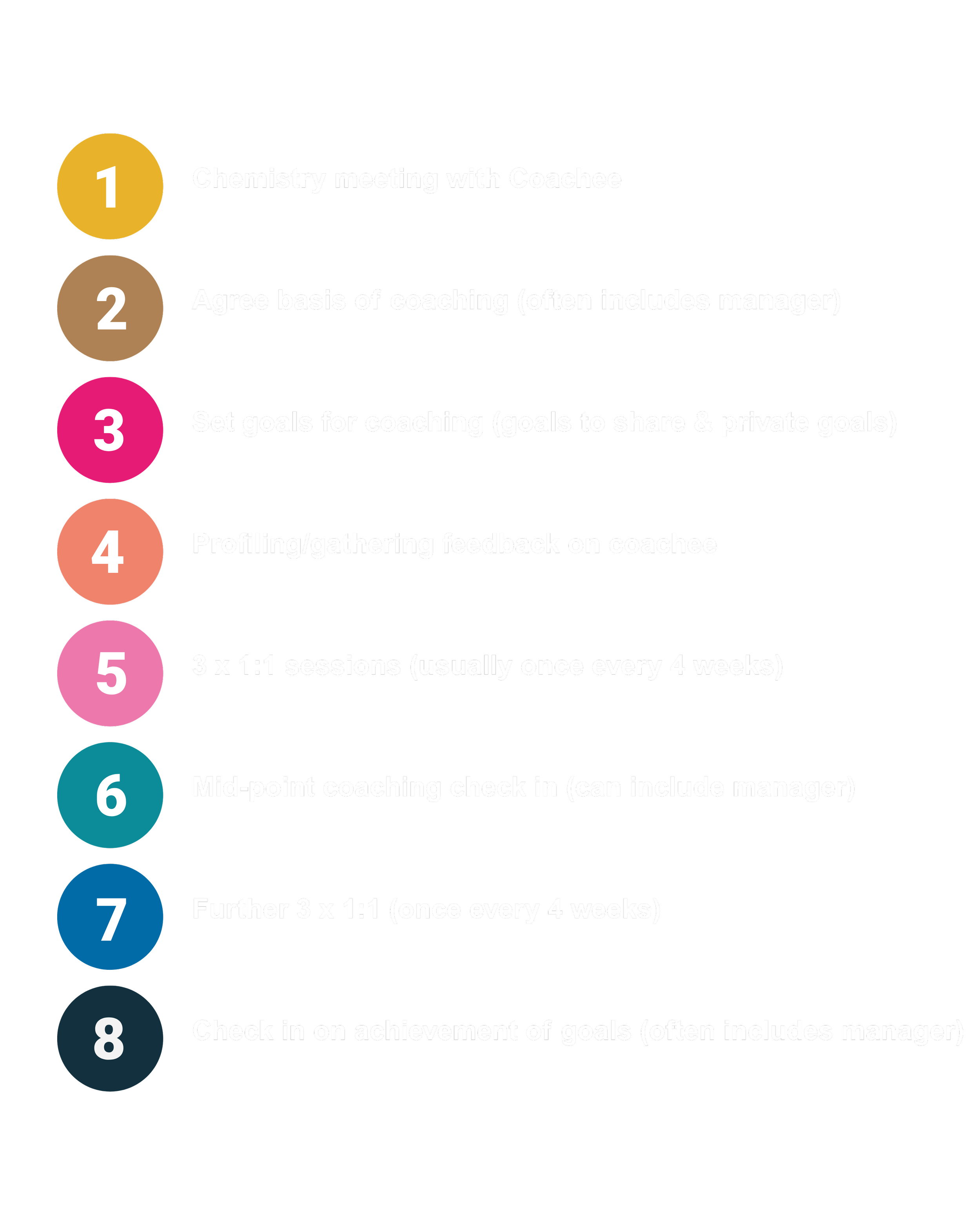
But the typical structure for an organisational coaching engagement runs across eight stages over six to nine months.
Sessions are usually four to six weeks apart and will be 90 mins or 2 hours each.
Between sessions you will work and experiment on practical steps you discuss with your coach. Adding on demand coaching can be useful when you’ve got a knotty problem to work through.
For individuals who are self-funding their own coaching, the structure is similar but simpler - there's no three-way meeting with a manager.
We agree the focus together at the start, work through the sessions, and review progress together at the end.
-
People tend to use a coach when they need thinking time and support to work through a transition or challenge.
Some of the most common situations:
Working out what career steps or wider life choices to take.
Navigating transition points in a career — promotion, maternity or paternity, moving internally, secondment.
The first 100 days of a new job.
Strategic planning and project thinking.
Developing as a leader in a changing organisation.
Building helpful habits that shift and sustain performance.
Managing balance in life and dealing with stress or overwhelm.
Driving business growth.
Thinking time when things are getting tough, or when there's a difficult problem to solve.
Building confidence.
Finding your purpose and motivation.
Fixing something that's holding you back - keeping calm under pressure, overcoming self-doubt, having difficult conversations and being able to influence change.
That said, coaching benefits people in any phase of their career if they have an open mind and are ready to develop. A common theme among high achievers is the desire to constantly learn, evolve and develop the skills they already have.
Coaching is one of the most proven ways to unlock untapped potential.
-
It's simple - it works. The exact return on investment is complex to measure.
PwC and Microsoft’s research found that the average return for companies investing in coaching was 700% on their initial investment. By any standards, that's a good investment.
Coaching works because people are:
More likely to act on the changes they've identified, because they came up with the idea themselves.
Often unaware of their own potential. Most people have far more untapped potential than they realise, and coaching helps surface ideas and thinking that haven't yet been drawn out. Or -
Sometimes resentful of being told what to do. This is common in intelligent, successful people who've solved their own problems in the past. Coaching helps them think clearly through their issues and choose an approach that is bespoke and they're genuinely committed to.
-
Choosing a coach is a personal decision. You're choosing a partner for an important phase of work, not just buying a service. This work is relational.
Some things I encourage people to look for:
A coach you feel you can be honest with, and feel safe to talk openly with. Someone you feel seen by, not judged.
Depth of experience - someone who can really navigate complexity with you, not just ask questions and leave you wondering what next.
A clear process you understand the shape of. You should know what working with them will actually look like.
The ability to challenge with care and in the right way - helping you stretch without overwhelming you.
Chemistry. The conversation should feel natural, engaging and get you thinking differently.
Evidence of impact. Not just testimonials, but a way of working that creates real change beyond the coaching sessions themselves.
Ultimately, the right coach is the one who helps you think better, feel braver and take the next steps with more clarity.